Android Hackers will demonstrate Fully loaded Spying Applications & Mobile Botnet


THC2012

This Sunday, The Capital , New Delhi plays host to an International The Hackers Conference where blackhat hackers will discuss the challenges of cyber safety with security agencies.

Your smartphone is an always-on and always-connected digital extension of your life which will be used by attackers to covertly steal your sensitive data and spy on you. Mahesh Rakheja , An Independent Security Researchers and Android Developer/Hacker will demonstrate "Android Spy Agent".

This application allows us to remotely access the entire victim’s personal information and even though the confidential data available in the android cell phone. The type of personal information include the victim’s contacts, call logs, messages, browser’s history, GPS location and many more information directly available on the victim’s cell phone. 

Many-a-times we think that is there any way by which we can read the private sms of anyone. So here is the solution Mr. Mahesh will present in The Hackers Conference 2012 platform with Hundreds of advance features.
This application can also allows the attacker to remotely delete the data available on the victim’s phone. In order to perfectly work this application you have to gain access to the victim’s android cell phone for at least 20 seconds. You have to install the application and then restart the cell phone. After restart your application get automatically starts on the victim’s cell phone. Now you can access the victim’s cells information for any normal cell phone and get the response on it. The android spy agent will be hidden in the victim’s cell phone and not allows the victim to easily uninstall or delete it from the cell.

In Another Talk Android Hacker Aditya Gupta and Subho Halder will talk about "All your Droids belong to me : A look into Mobile Security in 2012". Researchers have developed and will Demonstrate  malware for Android phones that can be used as a spam botnet.

"The talk is about Android Malwares, Botnets and all the crazy stuff you have been hearing in the past. We will give an inside view on how the black hat underground uses this, to earn 5-6 digit income per month . For this, We will start off with creating an Android Malware, and then will gradually move on to the Botnet Part.", Aditya Gupta said.

Maintaining that a wide variety of services is being offered on the mobile platforms without proper security implementation, Anurag Kumar Jain and Devendra Shanbhag from Tata Consultancy Services will deliberate on the topic, "Mobile Application Security Risk and Remediation". They will highlight the need for application security in mobile applications, the threats in a mobile environment, key security issues that can creep in mobile applications, and suggests a secure development approach which can possibly safeguard mobile applications from becoming “sitting ducks” for attackers and mobile malware.

Experts from countries like Iran and Argentina will share space with Indian speakers in the day-long discussion at the India Habitat Centre. Yet another important issue The Hackers Conference 2012 will deliberate on is the Internet censorship in India.

For more details, go to www.thehackersconference.com

Source:TheHackerNews

Apple's Cook hints at upcoming iPhone 5... or something


CEO Tim Cook doesn't flatly rule out the possibility of a fall product transition, noting that there's "incredible anticipation out there for a future product."
Cook announces the Verizon Wireless version of the iPhone in 2011.
Apple management still isn't talking about the timeline for the arrival of an iPhone 5, but the company dropped a broad hint that past would be prologue.
There has been a flurry of iPhone 5 rumors of late but Apple, which is famous for not talking about its product plans, has remained mum about what's next for its best-selling smartphone.
Until today.
"Can you talk a little bit about that? What's the sequential change in margins you're talking about, and how much do you expect to get back in the December quarter?" an analyst from Barclays asked about the fall product transition. "Do you have any idea with the iPhone, how much rumors and speculations hurt sales?"
Playing this one close to his proverbial vest, CEO Tim Cook nonetheless threw down a few breadcrumbs.
"It's difficult to sort out. I am fairly convinced that there's an incredible anticipation out there for a future product. And as you would expect given what we would be able to deliver in the past...it's a reasonable amount. In terms of channel inventory, we put our current thinking in the guidance (CFO Peter Oppenheimer) provided you."
Not exactly a "no-way, are you out of your mind, fella?" response. Which is just what the chatterboxes who power the rumor mill were waiting for. So if it's not a flat "no," is it a "yes"?
Cook was also asked several times in roundabout ways about a smaller iPad to compete in lower price-band areas, such as that populated by Google's $199, 7-inch Nexus 7 tablet. He didn't take the bait.
"Our north star will be making the best products in the world -- that's what we breath, that's why we live and we are not changing that," he said. " Economic turmoil may push us from side to side, but we're going to stay focused on making the best product. We've seen again and again over the years, that this is when we distance ourselves further from people who don't innovate."
He allowed that Apple could be more aggressive on price points. "We did that with the $399 iPad a few months ago, and the iPhone 3GS, which is free on contract in the U.S. and a few other places," Cook said.
The speculation will continue, and that appears to please Cook. "I am glad people want the next thing, I'm superhappy about that," he said. "I'm not going to put any energy into getting people to stop speculating."

Iranian nuclear program hit by AC/DC virus


Iranian+nuclear+program+hit+by+AC+DC+virus

A scientist working at the Atomic Energy Organisation of Iran said computer systems have been hit by a cyber-attack which forced them to play AC/DC’s Thunderstruck at full volume in the middle of the night.

The attack came to light after a researcher at security firm F-Secure received a string of emails from a Iran's atomic energy organisation."I am writing you to inform you that our nuclear program has once again been compromised and attacked by a new worm with exploits which have shut down our automation network at Natanz and another facility Fordo near Qom."
"It does sound really weird," he said. "If there was an attack, why would the attacker announce themselves by playing 'Thunderstruck?" If true, this attack is the third hacking attempt aimed at Tehran’s controversial nuclear program.

It sounds like the AEOI may have been hit with an infrastructure-targeting malware attack, similar to those that have plagued the Middle East since 2010 starting with Stuxnet. However, there’s no independent confirmation of this attack’s existence.

The scientist reported that the virus came through a simple and cheap open-source project that finds vulnerabilities in software.

See the full e-mail below:
I am writing you to inform you that our nuclear program has once again been compromised and attacked by a new worm with exploits which have shut down our automation network at Natanz and another facility Fordo near Qom.

According to the email our cyber experts sent to our teams, they believe a hacker tool Metasploit was used. The hackers had access to our VPN. The automation network and Siemens hardware were attacked and shut down. I only know very little about these cyber issues as I am scientist not a computer expert.

There was also some music playing randomly on several of the workstations during the middle of the night with the volume maxed out. I believe it was playing ‘Thunderstruck’ by AC/DC.

Source:TheHackerNews

8 million passwords dumped from gaming website Gamigo


The list of passwords, which were scrambled using a one-way cryptographic hash algorithm, were published earlier this month to a forum on the password-cracking website Inside Pro. According to forbe,"The list also contained 8.2 million unique e-mail addresses, including 3 million American accounts from the US, 2.4 million accounts from Germany, and 1.3 million accounts from France."

Gamigo warned users in early March that an attack on the Gamigo database had exposed hashed passwords and usernames and possibly other, unspecified additional personal data. The site required users to change their account passwords.

PwnedList founder Steve Thomas said, “It’s the largest leak I’ve ever actually seen. When this breach originally happened, the data wasn’t released, so it wasn’t a big concern. Now eight million email addresses and passwords have been online, live data for any hacker to see.

This breach is bigger than anything we've seen so far this year. In the last few months, there have been a slew of attacks against the following sites: LinkedIn, eHarmony, Last.fm, Yahoo, Android Forums, Formspring, and Nvidia, among others.

Gamigo users can check on PwnedList’s site whether their email address is included in the leak.

On March 1, Gamigo sent out the following e-mail to its users:

Dear Community,

As you have all already noticed, our game servers, websites and forums are partially unreachable at the moment. We would like to explain to you what happened and what has been done on our side.

There was an attack on the gamigo database in which user information, such as alias usernames and encrypted passwords were stolen. An excerpt from these was published in the gamigo forums. We detected the attack and are working to the utmost of our resources to repair the damage and determine how it happened.

Your character data, including items, is safely stored on the backup! We cannot rule out that the intruder(s) is/are still in possession of additional personal data, although to date we have received no report of any fraudulent use.

To prevent any unauthorized access to your account, we have reset all passwords for the gamigo account system and for all gamigo games!

Source:TheHackerNews

Apple OS X Mountain Lion Goes on Sale


osx-mountain-lion-600

For Mac owners, it’s Christmas in July again.
In its earnings report Tuesday, Apple officially announced that the long-anticipated Mountain Lion, otherwise known as OS X 10.8, would go on sale first thing Wednesday morning — just as predicted.
Costing $19.99, it will be available in the Mac app store only. Anyone who bought a new Mac on or after June 11 is entitled to a free upgrade.
Apple is making a habit of releasing new versions of the Mac OS in July; that’s when we got our first taste ofOS X 10.7, known simply as Lion. That, too, was announced on the company’s earnings call and made available the following morning.
Lion is now used by 40% of Mac owners, according to Apple. Some 50% are still using the previous version,Snow Leopard. Lion was criticized by some for being a minimal upgrade that removed some much-loved features, such as replacing the “save as” with the less user-friendly “export.”
Mountain Lion, by contrast, is a significant upgrade that adds plenty of integration with the iPhone and iPad operating system, iOS. Users will see their Reminders, Messages, Notes and other notifications automatically synced between devices.
The upgrade also allows you to post to Twitter, Flickr, Vimeo and other services from within every page and window. At Apple’s recent Worldwide Developers’ Conference, CEO Tim Cook boasted that Mountain Lion added more than 200 new features.
It’s only for current Lion or Snow Leopard owners, however; if you’re one of the few Mac users on a previous version, you’ll have to upgrade to Snow Leopard before buying Mountain Lion. And if you’re on a pre-2009 Mac, chances are your computer won’t have enough power to run Mountain Lion.
Stay tuned for our full Mountain Lion review Wednesday, and let us know in the comments: are you ready to buy?

Anonymous Hackers Help WikiLeaks to get Syria Files

wikileaks-580-75

Just after WikiLeaks began releasing the data from the Syria Files, Anonymous hacktivists claimed responsibility for accessing the information and passing it on to the whistleblower organization.
 
Anonymous supplies WikiLeaks with over two million e-mails from Syrian political figures, ministries and companies. According to Report, Anonymous Syria, Antisec and Peoples Liberation Front breached domains and servers in Syria since February, downloaded data over weeks and handed them to WikiLeaks.

In February, the hacker team had "worked day and night" to create a massive breach of multiple domains and dozens of servers inside Syria, the statement claimed.

In its intro to the e-mail cache, WikiLeaks indicated that they came from 678,000 individual e-mail addresses and 680 domains, including ones belonging to Syria’s Ministries of Presidential Affairs, Foreign Affairs, Finance, Information, Transport and Culture. At least 400,000 of the e-mails are in Arabic and 68,000 are in Russian.

“So large was the data available to be taken, and so great was the danger of detection (especially for the members of Anonymous Syria, many of whom are ‘in country’) that the downloading of this data took several additional weeks,” the release said.

The amount of data turned out to be so massive that downloading it required several weeks. While Anonymous published some e-mails from the personal accounts of President Bashar Assad and his wife Asma back in March, most of the data were passed onto WikiLeaks, an organization that was “supremely well equipped to handle a disclosure of this magnitude.

This is not the first time Anonymous and WikiLeaks have collaborated. Last December, Anonymous had hacked five million e-mails from security firm Stratfor, and reportedly sent those e-mails to WikiLeaks, which published them in February.

SOURCE:TheHackerNews

Facebook Partners With NBC for Olympics Coverage

 
Facebook and NBC are expected to announce a collaboration Wednesday for trans-media coverage of the upcoming Olympic Games.
The deal, reported in The New York Times, means NBC will be able to tap Facebook data to inform its TV coverage. One manifestation will be a “Facebook Talk Meter,” that will display what viewers are chattering about related to the Games. In an interview with The Times, Gary Zenkel, the president of NBC Olympics, said that the social network’s huge size (900 million users and counting) plus its young-skewing demographics were a key draw. Zenkel characterized the Facebook overlay as part of “our continuing efforts to reassemble the audience” that has splintered with the introduction of digital media.
No money is changing hands in the deal, according to the report, which assumes that both will benefit from the collaboration. NBC will be streaming the games online, but users will have to verify that they have a cable or satellite provider. For its part, Facebook has already attempted to position itself as the go-to destination for information about the Games with its 2012 Olympics Hub, which it introduced last month.
The deal also follows a similar collaboration with CNN for 2012 political coverage that was announced on Sunday.
Meanwhile, Twitter, which recently announced a cross-platform agreement with ESPN, is also expected to link up with NBC for this year’s Olympics coverage, according to the report.

Google to Pay Record $22.5 Million to Settle Privacy Charges

google-magnifying-glass-600Google is nearing a deal to pay a record $22.5 million to settle charges that it violated the privacy of millions who used Apple’s Safari browser.   
The Federal Trade Commission settlement, which may shape up to be the largest fine in the FTC’s history, was first reported by The Wall Street Journal, which based the story on information from “officials briefed on the settlement terms.”
Google was accused of privacy violations by the FTC for using a work-around to track Safari users’ web surfing habits even if those users activated a Safari feature designed to prevent tracking. Google stopped the practice after an earlier Wall Street Journal report about the situation.
“The FTC is focused on a 2009 help center page. … We have now changed that page and taken steps to remove the ad cookies,” a Google spokesperson told The Wall Street Journal.
The investigation leading to the settlement was sparked after FTC regulators set off to determine if the Safari tracking violated the company’s 20-year agreement to be transparent about its privacy practices.


The FTC has recently come to see itself as something of a privacy watchdog in the digital age. In May, FTC chairman Jon Leibowitz said the Commission has protected “the privacy of more than a billion people around the world.”
Exact terms of the settlement are still being discussed. If Google is fined $22.5 million, that number amounts to what the company makes in approximately five hours.

Thousands May Lose Net Access On July 9th July


DNSChanger+Malware
The warnings about the Internet problem have been splashed across Facebook and Google. Internet service providers have sent notices, and the FBI set up a special website.

Thousands of Canadians could be among the hundreds of thousands of people around the world who might lose Internet access on July 9.That's the day the FBI will shut down all the "clean servers" it set up to combat a massive hacking operation.
 
Last November the FBI arrested and charged six Estonian men behind the malware as part of Operation Ghost Click. These hackers were able to make a fortune off their project, raking in millions for ads placed on their fraudulent websites.On the eve of the arrests, the FBI hired Paul Vixie, chairman of the Internet Systems Consortium (ISC) to install two temporary Internet servers that would prevent infected users from losing access to the Internet once the DNSChanger botnet was shut down.
 
DNS (Domain Name System) is a core Internet technology used to convert human readable domain names suchasfacebook.com into an IP address such as 10.181.211.1, which a computer understands.

It's estimated that there is still around 277,00 infections worldwide, despite a massive clean up operation. If you're concerned about your own PC, or family members, then there's a DNS checker website or more information over at the DNS Changer Working Group.

Running the temporary servers for eight months has cost the FBI $87,000. Both Facebook and Google created their own warning messages that showed up if someone using either site appeared to have an infected computer. Facebook users would get a message that says, "Your computer or network might be infected," along with a link that users can click for more information.Google users got a similar message, displayed at the top of a Google search results page. It also provides information on correcting the problem.

Ensure that the DNS Servers are not within the following range of Internet Protocols (IPs):
- 85.255.112.0 through 85.255.127.255
- 67.210.0.0 through 67.210.15.255
- 93.188.160.0 through 93.188.167.255
- 77.67.83.0 through 77.67.83.255
- 213.109.64.0 through 213.109.79.255
- 64.28.176.0 through 64.28.191.255

If DNSChanger is detected, users may use software from McAfee, Kaspersky Labs, Microsoft, Norton, or Trend Micro to clean the infection.

Fujitsu cracks 278-digit crypto in 148 Days using 21 PCs

Fujitsu+cracks+278-digit+crypto+in+148+Days+using+21+PCs

A team of researchers in Japan have successfully broken a 278-digit piece of crypto in less than 200 days. Fujitsu Laboratories Limited, National Institute of Information and Communications Technology (NICT) and Kyushu University jointly broke a world cryptography record with the successful cryptanalysis of a 278-digit (923-bit)-long pairing-based cryptography, which is now becoming the next generation cryptography standard.
 
"We were able to overcome this problem by making good use of various new technologies, that is, a technique optimising parameter setting that uses computer algebra, a two dimensional search algorithm extended from the linear search, and by using our efficient programing techniques to calculate a solution of an equation from a huge number of data, as well as the parallel programming technology that maximises computer power."

This doesn't mean that pairing-based cryptography, which is rapidly becoming a go-to standard in crypto, is now useless. (It's to be used in everything from securing government networks to locking down financial systems.) Rather, the research is intended to establish just how long keys need to be in order to be reasonably secure against attacks by efficient algorithms and powerful computers.

Their work smashes the previous record of a 204 digit (676 bit) system which Japan's Hakodate Future University and NICT managed in 2009.Fujitsu claimed that today’s record required several hundred times the computational power of the 2009 effort – in effect this amounted to 21 PCs, or 252 cores.

Fujitsu also said it used a parallel programming technology that maximises computer power to complete the task.The Japanese firm was keen to note that the result of the diciphering is more than just a new world record.

Amazon Building an iPhone Competitor


As competition in the fast-growing mobile web space continues to heat up, Amazon is working on a device to grab a slice of the pie currently dominated by the iPhone and Android smartphones, according to a Bloomberg report.
Interestingly, the hardware, cloud computing and e-commerce juggernaut is said to be working with Foxconn — which has come under intense scrutiny in the past year for working conditions in the Asian factories where it manufactures Apple gadgets — to create the Amazon iPhone competitor.

Bloomberg‘s report is based on “two people with knowledge of the matter.”
Amazon is also reportedly seeking to acquire a wide range of smartphone-related patents to guard against infringement accusations. That’s likely motivated in large part by Apple’s recent success in getting a U.S. District Court judge to grant a preliminary injunction blocking sales of Samsung’s Galaxy Nexus — currently the only smartphone capable of running the Android operating system’s most recent version. 

Amazon’s Kindle Fire tablet has emerged as a very popular lower cost alternative to the iPad among consumers, so an Amazon smartphone does have some precedent for potential mobile success. A decent Amazon smartphone would also help it continue to reap profits through selling digital media including books, movies and music.

The future of the web is widely accepted to revolve around mobile access — and competition among tech companies is becoming increasingly fierce as hardware and software manufacturers jockey for position and profits in the next generation of consumers’ online lives. 

Last month, for example, Microsoft and Google announced tablet offerings meant to take on the iPad as smaller, more portable alternatives. In response, Apple is now said to be planning an “iPad mini” for release in time for this year’s holiday season.

Do you think Amazon would be wise to get into the smartphone market — or is that waste of time and resources for Jeff Bezos and company? Share your opinion in the comments.

Blink(1) the USB RGB LED

BLINK(1), THE WORLD'S BEST INDICATOR LIGHT


blink(1) is a super status light: it packs three dimensions of information (color, brightness and pattern) into a single tiny package that fits into any USB port on nearly every device. It makes it incredibly easy to connect any data source in the cloud or on your computer to a full-color RGB LED so you can know what's happening without checking any windows, going to any websites or typing any commands.
We designed blink(1) in the spirit of our favorite old school Unix tools and we tried hard to make it simple, flexible, and robust.
Do you want to know if a friend has signed onto Skype, but don't want a window popping up every time anyone has logged on? Do you want to be notified when a long download has finished? Do you want to know the snow conditions at Tahoe without checking every hour? Do you want to make a "busy" light for your office that glows red when your calendar says you're in a meeting?
You can do all four at once: you can simultaneously control as many blink(1)s as you have USB ports. Have a 36-port USB hub? You can fill it with 36 blink(1)s, each of which is showing a different piece of information.

BLINK(1) AT HOME

Get things done without having your face buried in the computer. If you're expecting a call and don't want to make noise, blink(1) can help.


blink(1) in the home

BLINK(1) ON THE GO

Monitor network speed when you're in the cafe, so you know when the guy in the corner is seeding on BitTorrent and it's time to go elsewhere.


blink(1) at a cafe
blink(1) at a cafe

BLINK(1) AT WORK 

Ever wanted a physical "Busy" indicator for your cubicle or office?  With blink(1) and a USB extension cable, you can let your coworkers know when you really can't be interrupted.
And because blink(1) is physically unobtrusive and requires no drivers to confound the OS, it makes a great multi-modal notification light for rack-mounted servers, alerting to task updates or system alerts. 


blink1 in a server farm

CROSS PLATFORM EVERYWHERE

blink(1) is a USB HID device, so no special drivers are needed, just applications. We provide apps for Mac OS X, Windows, Linux, and embedded Linuxes like those used on BeagleBone and DD-WRT.
On Windows, blink(1) can appear as a system service.  On Mac OS X, it can be an Applescript target.  On Linux it's a command-line tool.


blink(1) works on most everything with a USB port

WHAT'S WITH THE NAME?

The name "blink(1)" is a play on the Unix help system ("man pages") where command's help pages are given by their name and section.

OPEN SOURCE

Not only are the blink(1) tools and apps open source, so is its entire design.  Feel free to hack it to make it do cool new things.


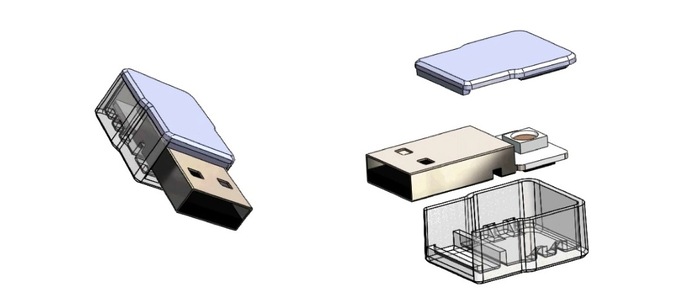
blink(1) internals
blink(1) internals

WHERE WE'RE AT

blink(1) builds on our experience making thousands of BlinkMs, the popular Smart LEDs for Arduino.We wanted something that is as fun and as useful as BlinkM, but made for everyone, not just prototypers and designers.


blink(1) enclosure concept 5

FAQ

Q. Wait, so this is just an RGB LED with a USB connector in a case? A. Yes, and it's the most flexible and easiest to use one, anywhere. To make it all work, there's also a tiny USB controller with our firmware to make it easy to program and control, but basically yes.

Q. Which computers does blink(1) work with? A. Just about anything with a USB jack.  Specifically, blink(1) is a USB HID-compliant device and the apps we release for it work on Mac OS X 10.6+, Windows XP+, Ubuntu/Debian-style Linux.  The command-line tools can be compiled for just about any POSIX-compliant Unix-style platform including the Raspberry Pi, DD-WRT WiFi routers, BeagleBone, and some Android phones.

Q. Can I hook it to my Twitter? A. Yep!  Our BlinkATweet app lets you control blink(1) based on Twitter keyword search or Twitter user post.

Q. What other web apps does blink(1) work with? A. At launch we plan on having blink(1) work with Twitter, Facebook, Pinterest, and through IFTTT.com, Boxcar.io many other web services.

Q. Can I control it from my phone? A. Yes! If your phone can load a web page it can control blink(1). The blink(1) service on your computer can appear as a password-protected web app for your phone or any other network enabled device. 

Q. Is blink(1) hackable? A. Definitely. We're working to make the enclosure openable so you can get at the circuit board. And if you know Arduino or AVR programming, you can modify how blink(1) functions. blink(1) can be programmed with the Arduino IDE. We will include example hacks of how to turn the blink(1) into a USB keyboard and mouse emulator.

Amazing Cheat Sheet Shortcuts for Google+ Power Users

Google+ a free social networking service by google which is continuously trying to gain some more public exposure day by day revealing some more good and worthy features daily, improving their layout making it much more innovative and easy to use. Google+ widgets for website also makes sharing content on that platform much more easier. Below are some of the cheat codes or shortcuts whatever you wanna call them for using Google+ as a power user.
google+ cheat sheet

Facebook Wants to Be the ‘Second Screen’ of Election 2012 Coverage


Facebook is teaming up with CNN to socialize coverage of the 2012 election, as the social network aims to become a “second screen” for political coverage. 

The new experience, “America’s Choice 2012,” will encourage Facebook’s 160 million U.S. users to share their political views through an app, buzz measurements and surveys. The two companies will aggregate users’ sentiment and CNN will incorporate the findings into its coverage.

“Each campaign cycle brings new technologies that enhance the way that important connections between citizens and their elected representatives are made,” said Joel Kaplan, Facebook’s vice president of U.S. public policy. “Though the mediums have changed, the critical linkages between candidates and voters­ remain. Innovations like Facebook can help transform this informational experience into a social one for the American people.”

One component of the initiative, a yet to be launched “I’m Voting” Facebook app will be a platform for endorsing different candidates and issues. Once you express your support, it will appear on your timeline, news feed and your friends’ tickers. The app will also show if you’ve enlisted friends to support issues or candidates. Users’ endorsements will be displayed on a map of the U.S., broken down by state.

CNN journalists will use I’m Voting to ask Facebook users questions about the races and integrate answers into their coverage.
Online chatter occurring outside the app will be measured and integrated into CNN’s coverage as well.

The final aspect of the announced plans are CNN-crafted surveys, polling voting age Facebook users about hot topics surrounding the party conventions, presidential debates and election day. The results will be published on CNN, CNN.com and Facebook’s U.S. Politics page.
Are you comfortable expressing your political views on Facebook? 

Do you think this partnership is innovating in the news gathering space?

If Hackers Didn’t Exist, Governments Would Have to Invent Them


The hackers who dominate news coverage and popular culture — malicious, adolescent techno-wizards, willing and able to do great harm to innocent civilians and society at large — don’t exist.
The perceived threat landscape is a warped one, which directs attention and resources to battling phantoms, rather than toward preventing much more common data-security problems. According to the Privacy Rights Clearinghouse, the loss or improper disposal of paper records, portable devices like laptops or memory sticks and desktop computers have accounted for more than 1,400 data-breach incidents since 2005 — almost half of all the incidents reported.
More than 180,000,000 individual records were compromised in these breaches, which included individuals’ names, Social Security numbers, addresses, credit-card information and more. This is compared to the 631 incidents from the same period that the Clearinghouse assigns generically to “hacking or malware.” Your private data is more likely to be put at risk by a factotum leaving a laptop on a train than by a wired teen with too much time on his hands.
Insider threats, otherwise known as frustrated grown-ups with real jobs, also constitute a significant challenge for information security. The Wall Street Journal recently reported on a survey which showed that 71% of IT managers and executives believe insider threats present the greatest risk to their companies.
And the recent high-profile security breach at LinkedIn shows that one of the greatest risks to our personal security is ourselves: more than two-thirds of the leaked LinkedIn passwords were eight characters or fewer in length, and only 1% used the mix of upper- and lower-case characters, numbers and symbols that makes passwords difficult to crack.
But these more serious threats don’t seem to loom as large as hackers in the minds of those who make the laws and regulations that shape the Internet. It is the hacker — a sort of modern folk devil who personifies our anxieties about technology — who gets all the attention.
The result is a set of increasingly paranoid and restrictive laws and regulations affecting our abilities to communicate freely and privately online, to use and control our own technology, and which puts users at risk for overzealous prosecutions and invasive electronic search and seizure practices. The Computer Fraud and Abuse Act, the cornerstone of domestic computer-crime legislation, is overly broad and poorly defined.
Since its passage in 1986, it has created a pile of confused caselaw and overzealous prosecutions. The Departments of Defense and Homeland Security manipulate fears of techno-disasters to garner funding and support for laws and initiatives, such as the recently proposed Cyber Intelligence Sharing and Protection Act, that could have horrific implications for user rights.
In order to protect our rights to free speech and privacy on the internet, we need to seriously reconsider those laws and the shadowy figure used to rationalize them.
The hacker character in mainstream culture has evolved as our relationship with the technology has changed. When Matthew Broderick starred in War Games in 1983, the hacker character was childish, driven by curiosity and benign self-interest, and sowed his mayhem largely by accident. Subsequent incarnations, like those inHackers, Sneakers, GoldenEye and Live Free or Die Hard became more dangerous and more intentional in their actions, gleefully breaking into protected networks and machines and causing casual destruction incomprehensible to techno have-nots.
The hacker in American film, almost always white, middle class and male, is immature, socially alienated, vindictive and motivated by selfish goals or personality problems. The plots of such films are built on apocalyptic techno-paranoia, reflecting a belief that hackers have supreme control over the technologies that make the world run.
News coverage parallels the pop culture frame. Basement-dwelling hackers remain a primary villain on the evening news and the front page, even at the cost of an accurate and rational portrayal of current events. “Hacking” is used as a catch-all term to describe almost any computer-related crime or “bad” action, no matter the skills or techniques involved.
Coverage often confuses what could happen with what is actually happening, reporting on theoretical exploits of the type often presented at security conferences as if they were a clear and present danger. Recent media and government fixation on the prankster-protesters of Anonymous has stoked the fires of techno-paranoia and, as Yochai Benkler pointed out in a recent article in Foreign Affairs, has conflated modes of electronic civil disobedience with outright cybercriminality in ways that damage the cause of political speech online.
The hacker lurks in the network, a decentralized threat, able to cause harm far from his actual location. His relationship with technology is pathological, he is compulsive in his hacking activities and therefore cannot be reformed. Because he is socially alienated, he lacks the normal social checks on his behavior, and is instead stuck in a feedback loop with other hackers, each trying to outdo the other in juvenile mayhem on the public internet. Add to all this the hacker’s superhuman ability to manipulate anything running code, and you have a terrifying modern boogeyman that society must be protected from at all costs.
In the effort to protect society and the state from the ravages of this imagined hacker, the US government has adopted overbroad, vaguely worded laws and regulations which severely undermine internet freedom and threaten the Internet’s role as a place of political and creative expression. In an effort to stay ahead of the wily hacker, laws like the Computer Fraud and Abuse Act (CFAA) focus on electronic conduct or actions, rather than the intent of or actual harm caused by those actions.
This leads to a wide range of seemingly innocuous digital activities potentially being treated as criminal acts. Distrust for the hacker politics of Internet freedom, privacy, and access abets the development of ever-stricter copyright regimes, or laws like the proposed Cyber Intelligence Sharing and Protection Act, which if passed would have disastrous implications for personal privacy online.
The hacker folk devil as depicted in popular culture and news coverage is the target of and the justification for these laws and regulations. But rather than catching that phantom, these laws invite guilt by association, confusing skill with computers with intent to harm. They snag individuals involved with non-criminal activities online, as happened in the case of Bret McDanel, who served 16 months in prison for sending a few emails, and leave the rest of us with legally crippled technology and a confused picture of our rights online.
Crafting governmental and corporate policy in reaction to a stereotyped social ghoul lurking in the tubes is ineffective at best, and actively malignant at worst. There are real threats in the online space, from the banal reality of leaving a laptop on the bus and sloppy personal security habits to the growing reality of inter-state cyberwar.
However, focusing on the boys-in-the-basement hacker threat model drains attention and resources from discovering what and where the actual threats are. Taking down file lockers, criminalizing jail breaking, modding and terms-of-service violations and casting legal aspersions on anonymous and pseudonymous speech online is distracting fear mongering and wastes governmental and corporate resources.
Recent court decisions, like the opinion handed down by the Ninth Circuit in US v. Nosal, work to narrow the scope of the CFAA, which gives hope to the idea that it is possible to regulate the Internet in a more reality-driven way.
In order to achieve that regulation, though, we must discard the hacker stereotype as a central social villain and legal driver. The past few years have seen the internet emerge as a central haven for political speech, domestically and internationally. The Internet has been used to exchange ideas, organize protests and overthrow dictators.
We hold the right to free political speech dearly in this country, and, for better or for worse, the laws we pass regarding the regulation of the internet have a disproportionally large impact on the way this international resource operates. The question that we must ask ourselves is, do we want the next Arab Spring regulated out of existence by our fear of hackers who don’t even exist?

6 Ways Google Can Secure its Social Future


David Clarke is CEO and co-founder of BGT Partners, a 2010, 2011 and 2012 Ad Age Top 15 Best Places to Work in the U.S. honoree. BGT creates interactive marketing and technology solutions for global corporations that strengthen brands, develop more engaging relationships, and transform businesses.
Social media has radically transformed the way we search, buy, and consume content online. Facebook has not only taken advantage of this, it’s become the driving force behind the new social web. Google Wave, Google Buzz and Google+ were all Google Inc.’s way of trying to win this war against Facebook, but the company is still far behind.
That’s because the current state of Google’s contribution is to act as the bottom feeder of social media, by collecting content from other social platforms, but doing little with it. Google’s biggest opportunity is to create a social ecosystem where content is created, distributed, marketed, attributed and measured. Here are five ways Google can do that, and secure its social future.

1. Buy a Social Media Dashboard/Distribution Tool

Success in social means you have to enable content creation, distribution, and integration. Facebook realized this long ago with the addition of its apps platform and now with the purchase of Instagram. Social media dashboards provide powerful content distribution features to most of the major social platforms.
This is why Google should consider buying TweetDeck (Yes, Twitter owns them. See bullet #2.), or HootSuite, as they both have a dedicated following, offer an engaging experience, and are constantly evolving. The data collected from TweetDeck or HootSuite would be extremely valuable to Google, as it’s one of the few companies that can monetize that data as it’s created and captured. If Google really wanted to, it could even integrate the content in real time, similar to a sports ticker, into Google Search. This would create a truly unique offering and a powerful tool.

2. Buy Twitter

This expensive piece of social real estate will get Google in the game much faster and raise its social credibility. Although Google did purchase Blogger in 2003, it still doesn’t have the social impact of a platform like Twitter. Not to mention, the huge cost and commitment that went into building and marketing Google+ has shown nominal results because it’s simply not better or different enough from other similar platforms.
More than anything, Twitter can be Google’s next YouTube. When Google was accused of overpaying $1.65 billion for YouTube in 2006, it understood that the sum of both companies was worth significantly more than the purchase price. Think Instagram. Who would pay $1 billion for a company that made no revenue? The answer is a company that could leverage the content and make it more valuable. If Google buys Twitter, it needs to integrate Twitter, not assimilate it.

3. Integrate Reporting into the Social Ecosystem

The future needs to be robust social reporting through Google Analytics that seamlessly integrates into the ecosystem. That means Google should incorporate PostRank and SocialGrapple into the social media dashboard. This will open up new opportunities for marketing, will tap into an existing audience of users and, most importantly, provide value to businesses by giving them access to rich consumer data.

4. Monetize Content

Monetizing content can be achieved in three ways: One, allow advertisers to advertise within their social ecosystem, similar to how Gmail serves up useful and relevant ads to its users. Two, provide marketers with more relevant social consumer data so they can better spend their advertising dollars. Three, tag social content and turn it into contextual ads, as Google is currently doing with Google+ and Gmail.

5. Succeed in Social Marketing Attribution

Social utopia for marketers is the ability to understand and measure social advertising or content and how this directly impacts conversions or goals. This is the final frontier and something Facebook has been slow to provide, probably because poor results will impact advertising spend.
Attribution is beneficial to Google, as it has a larger advertising network, makes little from its social initiatives, and Facebook advertising revenue is growing. Google Analytics is currently doing this in beta. However we have to wait and see how robust the functionality will be and if this will be integrated into the larger social ecosystem. Social attribution would give marketers the best reason to spend their advertising budgets with Google, and significantly differentiate Google from Facebook.

6. Purchase a Significant or Niche Social Site

The purchase of Zagat, fflick, and Angstro were fairly small and didn’t have the growth impact of a much larger social platform. Some better bets are Yelp and LinkedIn. Here’s why.
Yelp is a good match for its high-quality content and loyal audience. Also, it might be a good deal because Yelp could run out of money before it gets in the black. If Google really wants to buy something of substance, LinkedIn would be an extremely expensive purchase but would give Google the world’s largest business network. The potential of this combined company would be greater than the sum of the purchase. LinkedIn’s explosive growth in hiring solutions alone could be detrimental to Monster and CareerBuilder.
Yes, there’s a downside in building out this social ecosystem, as it could be used to help grow Google’s competition. But Google’s strength is its ability to make money on data, and social “frenemies” are a business reality. Google is far from throwing an AOL/Time Warner Hail Mary, and the company’s success in mobile gives it a huge runway to figure this out. However, at some point, Google’s growth will slow and more nimble, aggressive companies will innovate faster.

Google Chrome Web App Store Now Offers Suggestions From Friends


Now you can get recommendations on what apps, games, and add-ons to download from the Chrome Web App Store from your friends -– at least your friends on Google+.
Tuesday Google announced it was integrating Google+ into its Web App Store. The integration allows anyone to share their favorite Chrome Web Store items with people in their Google+ circles by clicking the +1 button beside those items in the store.
If you’re looking for things to buy, you can review theme, extension, and app suggestions from people in your Google+ circles by clicking the “From your circles” link in the left category menu of the Chrome Web Store. Suggestions are also available from people from the Chrome team.
While you’re just browsing the store, apps that your friends have +1’d will also be highlighted as such, so you can easily see at a glance what your friends enjoy.
Facebook recently launched a similar service last month for Android and iPhone apps. Called App Center, Facebook’s service lets you see at a glance what apps are popular as well as what apps your friends are using for both mobile devices as well as Facebook’s Timeline.
How do you currently find the apps that you choose to download? Can you see Google+ integration being useful when it comes to shopping in the Chrome Web Store? Let us know your thoughts in the comments.